Friday, September 07, 2012

"Houses Are for Occupancy"

From: The Unhappy Hipster
At First Presbyterian Church in Jackson, Minnesota, I've been preaching through the gospel of Matthew. The sermon text this week is Matthew 12:38-50. Here are verses 43:45 (Jesus is speaking):
“When the unclean spirit has gone out of a person, it passes through waterless places seeking rest, but finds none. Then it says, ‘I will return to my house from which I came.’ And when it comes, it finds the house empty, swept, and put in order. Then it goes and brings with it seven other spirits more evil than itself, and they enter and dwell there, and the last state of that person is worse than the first. So also will it be with this evil generation.”
About these verses, scholar and commentator Dale Bruner writes:
Empty, neutral, externally Christianized people sooner or later find their little passions - from civic clubs to sports, from politics to parlor games - insufficiently fulfilling. For our own good, therefore, Jesus summons us to 'Fill the house!' to join the church and to take her worship services seriously, to appropriate our filling by the Holy Spirit given to us in Christian baptism, and to become Jesus' disciples in the world of our work. For our empty, swept, tidy houses will be filled sooner or later by something, because houses are for occupancy.*
Emphasis added.

The question for the week: With what will you be fulfilled?

[Bruner, Matthew: A Commentary. Volume 1: The Christbook, 579.]

Monday, July 02, 2012

"All Concepts of Reality that Ignore Jesus Christ Are Abstractions"


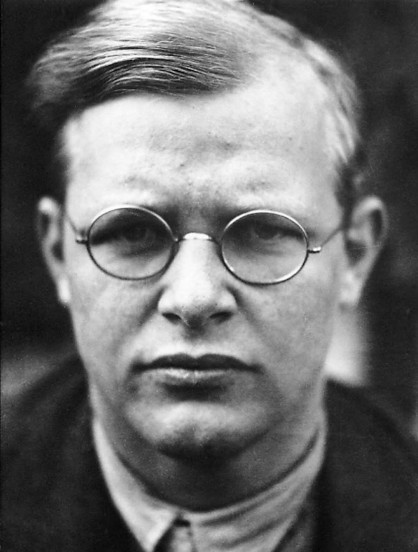
In his terrific biography of Dietrich Bonhoeffer, Eric Metaxas quotes from Bonhoeffer's Ethics:
In Jesus Christ the reality of God has entered into the reality of this world. The place where the questions about the reality of God and about the reality of the world are answered at the same time is characterized solely by the name: Jesus Christ. God and the world are enclosed in this name ... we cannot speak rightly of either God or the world without speaking of Jesus Christ. All concepts of reality that ignore Jesus Christ are abstractions.
Jesus is Lord over all.

Wednesday, June 20, 2012

Jesus in the Infrequented Text


And he said to them, “O foolish ones, and slow of heart to believe all that the prophets have spoken! Was it not necessary that the Christ should suffer these things and enter into his glory?” And beginning with Moses and all the Prophets, he interpreted to them in all the Scriptures the things concerning himself. - Luke 24:25-27 ESV

The church I serve has a Sunday morning class called "Bible 101." I launched the class soon after my arrival with the initial objective of reading through and discussing the first five books of the bible, called the Pentateuch. So far, this intrepid group has studied the entirety of Genesis, Exodus, and Leviticus. Three years into the class, we have now made it almost all the way through Numbers.

One of the things I try to do in the class is to demonstrate how these texts fit into the overall flow of salvation history. A paraphrased St. Augustine put it this way, "The New Testament is in the Old Testament contained, while the Old Testament is in the New Testament explained." I've taken this approach because of Jesus' critical teaching in Luke 24, where he explains to his disciples how the entire Old Testament is about him.

Every now and then, however, I need to be reminded of this truth, especially when examining infrequently studied texts.

Last Sunday was a case in point. The group studied Numbers 30, a chapter containing the law regarding oaths made to God. Remember the last time you heard a sermon on Numbers 30? Me neither.

Basically, the structure of the chapter is like this: Men are prohibited from making vows and then backing out of them when the underlying circumstances behind the vow change. The rules for women differ because they are understood to be under the authority of a head-of-household. For example, in the case of a never-married woman, her father has the right to cancel her vow if he so chooses. If a woman marries, this ability to cancel her vow becomes her husband's responsibility. Numbers 30 also gives instructions about vows to folks in other situations. An example would be cases where a woman is divorced or widowed and no longer attached to a head-of-household.

I walked the class through the text, and the biblical structure of the household. One of the things I pointed out is that women get the better deal in this chapter because, unlike the men, it is possible for them to get out of unwise, rash oaths made to God.  Having made this observation, which I thought was very astute, I asked if there were any questions. One of the participants then raised her hand and asked, "So what does this text tell us about Jesus?"

My immediate response was two-fold. First, I was thrilled that she asked the question, because it showed me that she had thoroughly learned that Jesus was serious in Luke 24 about everything in the OT pointing to him. My second response was one of dismay. How come I hadn't asked myself that question before showing up to teach that morning?

After giving it some thought I gave what I hope is an answer faithful to the story of salvation.  I remembered that the church is the bride of Christ and Jesus has the authority to loose and bind all things related to His Bride. The good news of the gospel is that Jesus not only fulfilled all of God's vows to His people, but also that he bore the full iniquity of every rash vow we have made with God and have broken due to our sinful forgetfulness and neglect. Jesus perfectly fulfilled Numbers 30 on Calvary.

Remember that Jesus is in every text. In some cases, we may not see Him, especially in those infrequently considered texts that we gloss over because we erroneously believe them to be superfluous or unimportant. But He's in those texts, too. We should not be fooled into thinking otherwise because of our inability to see properly.

Friday, June 15, 2012

Prayer Is the Mother of Mission

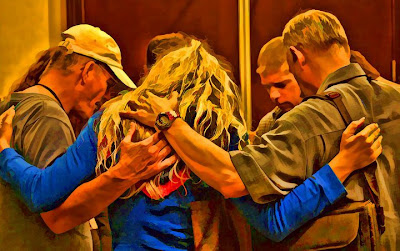
Praying for divine appointments by Chris Yarzab
Praying for Divine Appointments, by Chris Yarzab
Dale Bruner gives some convicting words on prayer as mission:
A creeping death sweeps over the mission of many churches in our time because, quite simply, prayer meetings have ceased.And beneath the death of prayer, at a deeper level, lies the death of a real belief that only Jesus literally saves people. Faith in Christ as sole savior has precipitously declined in mainline churches. But such faith is the mother of prayer, and prayer is the mother of mission.
From volume one of Bruner's Matthew: A Commentary, commenting on Matthew 9:35-10:4. Emphasis in the original.

Monday, June 11, 2012

The Faculty Speech - You Are Not Special

David McCullough, Jr. (son of historian and author David McCullough) recently gave a facinating faculty commencement address at Wellesley High School, where Dr. McCullough serves as an English Teacher.

The video of the address is just over 12 minutes in length and it's worth watching in its entirety:


One of the most compelling parts of the speech is where Dr. McCullough said, "[We] have of late, we Americans, to our detriment, come to love accolades more than genuine achievement." He continued:
We have come to see them as the point — and we’re happy to compromise standards, or ignore reality, if we suspect that’s the quickest way, or only way, to have something to put on the mantelpiece, something to pose with, crow about, something with which to leverage ourselves into a better spot on the social totem pole.  No longer is it how you play the game, no longer is it even whether you win or lose, or learn or grow, or enjoy yourself doing it…  Now it’s “So what does this get me?”  As a consequence, we cheapen worthy endeavors, and building a Guatemalan medical clinic becomes more about the application to Bowdoin than the well-being of Guatemalans.  It’s an epidemic — and in its way, not even dear old Wellesley High is immune… one of the best of the 37,000 nationwide, Wellesley High School… where good is no longer good enough, where a B is the new C, and the midlevel curriculum is called Advanced College Placement.
As I read that poignant phrase, "building a Guatemalan medical clinic becomes more about the application to Bowdoin that the well-being of Guatemalans," my mind went to the church. We need to be careful that the church not succumb to the unhealthy desire for accolades rather than the faithful obedience to Christ's commanded mission to make disciples. We cannot be satisfied to simply be seen as helpers, or to be "missional" (whatever that means) in order to be "relavant." Relevance isn't the point. Faithfulness to the gospel of Christ is. If any pastor, church member, congregation, denomination, or other group seeks to be "missional" for the sake of gaining eyeballs, or penetrating that hard-to-reach "youth demographic," it runs the risk of compromising the truth - that Jesus Christ is Lord.

Indeed, "faith apart works is dead," (James 2:26). But so are works without faith.

Thursday, May 24, 2012

The Gospel Way - A Prayer for the Day

Blessed Lord Jesus,

No human mind could conceive or invent the gospel. Acting in eternal grace, thou art both its messenger and its message, lived out on earth through infinite compassion, applying thy life to insult, injury, death, that I might be redeemed, ransomed, freed.

Blessed be thou, O Father, for contriving this way. Eternal thanks be to thee, O Lamb of God, for opening this way. Praise everlasting to thee, O Holy Spirit, for applying this way to my heart. Glorious Trinity, impress the gospel on my soul, until its virtue diffuses every faculty; Let it be heard, acknowledged, professed, felt.

Teach me to secure this mighty blessing; help me to give up every darling lust, to submit heart and life to its command, to have it in my will, controlling my affections, moulding my understanding; to adhere strictly to the rules of true religion, not departing from them in any instance, nor for any advantage in order to escape evil, inconvenience or danger.

Take me to the cross to seek glory from its infamy; strip me of every pleasing pretense of righteousness by my own doings.

O gracious Redeemer, I have neglected thee too long, often crucified thee, crucified thee afresh by my impenitence, put thee to open shame. I thank thee for the patience that has borne with me so long, and for the grace that now makes me willing to be thine.

O unite me to thyself with inseparable bonds, that nothing may ever draw me back from thee, my Lord, my Savior.

(From a collection of puritan prayers entitled The Valley of Vision published by Banner of Truth.)

Wednesday, March 21, 2012

QOTD - Reading the Fine Print

From Kyle Idleman's book Not a Fan:
For many Christians the concept of denying themselves was not part of the deal. They grew up with the message that such a radical decision really isn't necessary. So they signed up to follow Jesus, but if denying themselves was part of the explanation, it was definitely the fine print. That's especially true of American Christians. In part, this ids due to the collision of Christianity with American capitalism. It has created a culture of consumers in our churches. Instead of approaching their faith with a spirit of denial that says, "What can I do for Jesus?" they have a consumer mentality that says, "What can Jesus do for me?"
Emphasis added.