This responsory list is making the rounds in the blogosphere. Thanks to
The Anchoress for inspiring me to supply my own responses (I needed the break from my remaining school projects):
1. Egg Nog or Hot Chocolate? Yes. Er... I have to pick? Okay. Whatever tastes better spiked with good Presbyterian Scotch. I'll go on a limb and suggest that eggnog wins the taste test. I'll try it out and let you know. Maybe.
2. Does Santa wrap presents or just sit them under the tree? Santa wraps, baby. The element of surprise is a key Santa-esque mark of authenticity.
3. Colored lights on tree/house or white? White, the white light pierced into the darkness of the world.
4. Do you hang mistletoe? No. I prefer to kiss only my fiancée, and we don't need encouragement from some silly piece of shrubbery.
5. When do you put your decorations up? Way to early, I'm afraid. We're in
Advent, people! Christmastide isn't for several weeks.
6. What is your favorite holiday dish (excluding dessert)? This is going to sound kind of lame, but I love mashed potatoes and giblet gravy.
7. Favorite holiday memory as a child? I remember my dad walking around with the 8mm movie camera with a HUGE lamp to light the scene.
8. When and how did you learn the truth about Santa? I learned the truth late in grade school. A friend disclosed the truth at church, of all places.
9. Do you open a gift on Christmas Eve? Never! (Almost.)
10. How do you decorate your Christmas tree? Mom has always decorated the family tree. She's so good at it that I've told her she should turn pro.
Seriously.
11. Snow! Love it or dread it? Totally love it. I'm a snowboarding fanatic.
12. Can you ice skate? Yes. Generally, I'm the source of great amusement when I ice skate.
13. Do you remember your favorite gift? Sara gives me most meaningful gift I've ever received - her love.
14. What’s the most important thing about the holidays for you? The Incarnation. Without that, we'd be lost.
15. What is your favorite holiday dessert? Pumpkin Pie with real whipped cream.
16. What is your favorite holiday tradition? Christmas breakfast with the family.
17. What tops your tree? An angel.
18. Which do you prefer, giving or receiving? I love watching the reaction of those I've given gifts.
19. What is your favorite Christmas song? The Truth from Above.
20. Candy canes: yuck or yum? I love 'em. Sticky good.
21. Favorite Christmas movie? Why,
A Christmas Story, of course. A classic. "You'll shoot your eye out, kid."
22. What do you leave for Santa? Chocolate chip cookies and an ice-cold glass of milk. This was an easy thing to remember, because chocolate chip cookies with ice-cold milk happens to be one of my dad's favorite evening time snacks.
Don?
Karen?
Sara?
David? What say you?


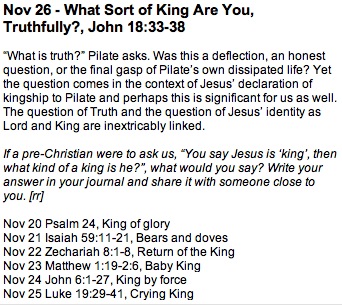
What Sort of King are You, Truthfully?
John 18:33-38a
Christ the King Sunday
© 2006 by Christopher D. Drew
Focus: Jesus makes the claim that he is King of a Kingdom that transcends our understanding of royalty and power and gives witness to the Truth. Our human institutions of power are ultimately subject to the authority of One Lord of Truth.
Function: To encourage listeners incorporate the claims of this One Lord of Truth into their family and professional lives, and in the covenantal relationships we have in the Church.
These past weeks I have been participating in Ron Ragsdale’s Midweek Moment class that is viewing and responding to John Eldredge’s wonderful book and video series called EPIC. I really like the class because it does a wonderful job of relating our stories with the grand story of God revealed to us through Scripture and in the person and work of Jesus Christ.
Early in the series, John Eldridge asks the penetrating question “What sort of tale have we fallen into?” As I have read today’s gospel text, the story of Pilate’s interrogation of Jesus, and have reflected on the time of the year, I ask myself the same question. What sort of tale have we fallen into?
Part of the answer is supplied by the calendar. This Sunday is referred to in the great circle of the church’s calendar as Christ the King Sunday. It is a significant inflection point in the recurring story of the universal church. Having just celebrated the Thanksgiving holiday, a holiday meant to acknowledge our place in the history of this nation, we now draw our eyes back once again, on Sunday, together with the world, to the risen Lord as we lay the groundwork for Advent. (Can you believe it? Advent is almost here.) The story of Christ the King is linked closely with the end-time theme of the first week of Advent and forms the narrative bridge between the “old” Christian year and the “new.”
This is a tale that moves swiftly as we march on toward Christmastide, so we might still be disoriented from having fallen into it. Our place in time is marked by images of the royal Christ. The forum for this image is the story of a trial, a trial where we are challenged to ask ourselves, “Just what it is about this man, Jesus, who we call and particularly acknowledge on this day as King?” We’re entering a story containing intrigue, the nature of God’s Kingdom, and the substance of what it is we call “truth.” As we consider Jesus in light of our text from the gospel of John, let us all keep in mind the question “What sort of tale have we fallen into?”
Let us pray:
Holy and merciful God, send your Spirit to illuminate our minds and hearts as your word is read and proclaimed in this place and time. We ask this in the name of Jesus Christ, our Lord, whom with you and the Holy Spirit we praise and honor and glorify this day and every day. Amen.
John 18:33-38a
33 Pilate then went back inside the palace, summoned Jesus and asked him, "Are you the king of the Jews?"
34 "Is that your own idea," Jesus asked, "or did others talk to you about me?"
35 "Am I a Jew?" Pilate replied. "It was your people and your chief priests who handed you over to me. What is it you have done?"
36 Jesus said, "My kingdom is not of this world. If it were, my servants would fight to prevent my arrest by the Jews. But now my kingdom is from another place."
37 "You are a king, then!" said Pilate.
Jesus answered, "You are right in saying I am a king. In fact, for this reason I was born, and for this I came into the world, to testify to the truth. Everyone on the side of truth listens to me."
38 "What is truth?" Pilate asked.
Our thinking about royal power and kingdoms is shaped and influenced by both our popular culture and by our politics, and our reactions to royal power run the gambit from ridicule, to suspicion, to fear.
Some of you may remember the popular family sitcom about the 1950s called Happy Days. You might remember that Ron Howard (who is now a famous film director) played Ritchie Cunningham. His dad, Howard Cunningham, aspired to and later became “grand Pooh-Bah” of Leopard Lodge No. 462 in Milwaukee, Wisconsin. He became the make-believe “king” of the local fraternal group. It seemed clear to me, when watching the show, that a certain social prestige was associated with the somewhat silly title “grand Pooh-Bah.” The term usually generates some degree of amusement, even laughter. “Grand Pooh-Bah” was created by Gilbert and Sullivan for their musical The Mikado.
In this operetta, the haughty character Pooh-Bah holds numerous exalted offices, including Lord Chief Justice, Master of the Buckhounds, Lord High Auditor, Groom of the Back Stairs, and Lord High Everything Else. The name has come to be used as a mocking title for someone self-important or high-ranking and who exhibits an inflated self-regard.
In our culture, we sometimes view royalty or superior social status with a similar degree of derision We frequently ridicule at the bumbling fool who has been put in charge for no other reason than by accident of birth or because the more qualified employee got wise and went looking for a better job elsewhere. We laugh because we have some sense of how inadequate any human is to the task of being royal.
Royalty isn’t all fumbling and bumbling incapable fools, though. There’s sinister side to royalty as well. In America, we treat kingdom talk with deep suspicion, borne out of our national historical struggle against Great Britain, and because we have adopted a system of government founded precisely upon the suspicion of those with ambitions to lead. Throughout history Kings (and Queens) of the earth have been said to hold their power through a “divine right” borne, in part, on an allegiance to the King of Kings! But the record of history causes us to view these claims with suspicion, too. And our suspicion is not unjustified. History is full of personalities who, having been proclaimed King or Queen, and having understood themselves to have the approval of the King of Kings, then utilized their power and authority for the perpetuation of all manner of evil: famine, slavery, and genocide are a few of the most unsavory examples. We are a people who don’t like the idea of a King. We are resistant to the notion that an entity apart from ourselves could ultimately hold sway over even the most basic decisions of our lives.
Even so, while we refuse to put a crown on anyone because we’re suspicious of one person who has all of the power, we’re not altogether immune to the tendency to put our trust in one, single entity, either. We frequently fall back into the view that a party or platform can save us. We had an election earlier this month. For some, this was an occasion for great wailing and gnashing of teeth. Our party lost. The gig is up. For some, there were feelings that ALL was lost. That the power to change things for the better had been transferred to those who have a wrongheaded approach for that which is best for this nation.
For others, the election was a time for great celebration. What was once lost has been regained. It’s our gig now. For some, there were feelings that NOW, we finally have a shot to get things right. The power to change things for the better had been transferred from those who have a wrongheaded approach for that which is best for this nation.
Now, you see the commonality between these two statements? Underneath both statements is this notion that we can rely, if not on a king, then on the political process (when we’re the winners) to save ourselves. And it is for this exact reason that we have the representative republic form of constitutional government. The other side cannot be trusted.
Is this power? Political institutions that fade in and out of first place? I think our gospel writer is suggesting something totally different. Today’s reading challenges us to rethink the notion of power, of having a king in our lives; one to whom we pledge total and complete allegiance; one who we acknowledge to be Lord of Life, one who Revelation 1:5 tells us is “the firstborn of the dead, and the ruler of the kings of the Earth.”
Our reading today is preceeded by the acocunt of the angry and suspicious crowds who have handed Jesus over to the Roman authority, Pontius Pilate. Pilate asks the crowd what Jesus has done, and according to John they gave the very vague answer: “If he were not a criminal, we would not have handed him over to you." Pilate decides to interview Jesus to find out what is going on such that the peace of the forthcoming Passover celebration is threatened.
Pilate asks, “Are you the King of the Jews?” This is a question firmly rooted in Pilate’s worldly experience in the Roman Empire. In the other Gospel accounts of this same interview, Jesus answers briefly, “You have said it.” But the expanded and detailed account in John’s gospel gives us a view into something much larger than a potential political dispute between Rome (represented by Pilate), and Israel (represented by the Crowds, the Chief Priests and others). John’s account is much more detailed because he seems very interested in witnessing to the Lordship of Jesus. This is reflected in Jesus’s next recorded statement, one that appears to be based on a suspicion of Pilate’s motive for asking his question. Does Pilate suspect that Jesus might be something more than the crowds have thus far portrayed? Jesus tests Pilate to see if his suspicion is accurate: “Is that your own idea,” Jesus asks, “or did others talk to you about me?”
Pilate’s reply is almost a scoff, “I am not a Jew, am I?” It seems, then, that Pilate is only familiar with Kingship as it relates to the context of Empire. The suspicion that he may be on to Jesus’ true nature is therefore unfounded. So, if Jesus is not a “king” in the sense that Pilate understands, then why has Jesus been brought to him at all? Pilate asks Jesus about this, “What is it you have done?” The chief priests and “people” have handed him over. Why all this trouble on the day of Preparation for Passover?
“My kingdom,” says Jesus, “is not of this world.” His Kingdom is not from around here. It’s not a Kingdom as we understand Kingdoms – with territory and replete with armies to defend, supplant, and conquer. No, not this King. Instead, we have the King who rules in a way utterly not like that found on Earth. If Jesus’s Kingdom were an earthly Kingdom, wouldn’t you expect armies of supporters responding to his command? Yes, indeed we would. But not here. Indeed, Jesus makes it clear that his Kingdom, because it is not of this world, is therefore not a threat to Roman authority per se. Instead, this is a Kingdom with the God of Love as its foundation. A love founded upon a kind of powerlessness that defies human expectation. A love founded upon the full faithfulness of the one loved. Jesus is our perfect exemplar of such love. It is a love that cannot be understood apart from the work of Jesus and the new commandment he gave in chapter 13:14 where he said “A new command I give you: Love one another. As I have loved you, so you must love one another.”
Jesus answers Pilate’s exclamation “You are a king, then!” in the affirmative. “You are right in saying that I am a king. In fact, for this reason I was born, and for this I came into the world, to testify to the truth. Everyone on the side of truth listens to me.” Yes, there is Truth, and a Way, and Life. It encounters us in the voice of the stranger, in the outstretched hand of the victim, of the less fortunate. The Truth is Love; and Love is commanded by this King. And it is for this reason that we give all glory and honor to our King. He is not the King who is representative of the truth. No. We ask, “What Kind of King are you, Jesus, truthfully?” He answers, “Your King is Truth and bears witness to the truth.” The truths we rely on in order to save ourselves are therefore inadequate to the task. There is no salvation to be found in our worldly Grand Pooh-bahs, or our political parties. There is no salvation to be found ultimately in any earthly institution. Our salvation rests with the King who is also Truth – and who rules a kingdom built on a foundation of Love – the Love that God has for the Son and that the Son has for His disciples. That’s you and me, folks. And we are not called to place our faith in an illusion. If we did, then we are to be greatly pitied. Our faith is real and founded upon the Truth of Christ, Jesus Christ the Nazarene. The one who was born before time, came into the world in the manger, the one who out of love for us was crucified for our salvation, and the one who will indeed come again. This, my friends, is the magnificent tale we’ve fallen into.
The truth is in Christ, but that’s not apparent to everyone. I invite you now to imagine that you are in this story, and that your name is Pontius Pilate. You’ve just met this man, Jesus, whom the crowd has accused of criminal acts. You investigate the man apart from his nation and its priests. You are able to conclude that he poses no direct threat to Roman Rule. But then this man starts talking about a different sort of kingdom, one for which there is no standard of comparison. This man makes the claim that he is a King of this weird, bizarre Kingdom founded not on the exercise of power but upon the power of love, a love is which amazing because it is premised on a kind of mutual laying down of power. Not only that, but this man tells you that he is witnessing and testifying to the truth – THE truth. Pilate’s answer indicates that he knows the tables have been turned, and that he’s been put in the dock by Jesus. Suddenly, the earthly judge is being judged by Truth. His response, “What is truth?” tell us that ultimately Pilate is unable to comprehend the full nature of a kingdom built on a foundation of love instead of raw human power.
Pilate couldn’t understand this different sort of Kingdom? Can we?
I think we can. Why? Because he have the spirit of Truth to help us, and we have the continuing sustenance of the waters of Baptism. The truth of Christ’s Kingdom is proclaimed by the local and international mission work of this church, by its charge to educate both young and old alike about Christian life and ongoing work of the Church in the world. We rehearse life in the Kingdom each week in the drama of our public worship, where the audience is not you or me but the Father, the Father’s whose kingdom has come, will come, and is continually breaking into our “reality” through the bread and wine, the body and the blood, of his most precious Son Jesus. It is to this place that we return to encounter the Lord of Truth.
Now, isn’t this an unlikely way for a kingdom to come and for a King to rule – in a meal of bread and wine, in baptismal water, and in caring for our neighbors? It is. It is a worldview different from the one we’ve been conditioned to by our culture. We are all called, as Jesus was, to bear the Truth into the world. We are all Christ’s ministers, and we are all called to share in Christ’s witness to the truth in the world. Moreover, we are called to witness to the Truth in Love, which means that we mutually lay down our power and engage the other as we engage ourselves. I believe this is what is meant with the Golden Rule. And of course, this image of power in powerlessness seems deeply contradictory. And it would be, if the power we witness to in Christ were simply a contractual arrangement between you and me and between other individuals in our church. But that is not how we’re called to relate to one another. We are a community in a covenantal relationship, which is a structured in a way much more open to the foibles of our human depravity, but also much more open to the potential fullness of human lives built in the image of Christ. We come into these covenantal relationships with trust, but also with forgiveness, because we all know we will, at one time or another, fall short of our true selves, the true selves Christ the King imagines for each of us. We also know that these relationships are not bilateral, because in as a covenant people we are not only obligated to each other but also to The King.
So this is the story we’ve fallen into. Christ witnessed to the Truth with Pontius Pilate and through the signs and wonders attested to in the Gospel. We, in turn, are called to witness to the truth using our human means. These include the Church and its missions, and the political realities of the world in the place and time in which we are born, and it includes the sacramental way in which we encounter Christ as Body and Blood, as Bread and Wine. We are cast in a story where we are continually invited to the table to dine with the King. As we receive the Cup and the Bread from the King, we are simultaneously empowered to serve each other in love and in truth as the King’s cupbearers and stewards.
Friends, this is the joyful feast of our Lord Jesus Christ, our King.
The people of God will come from the East and from the West, from the North and South, to sit at table in the Kingdom of God. This is the Lord’s Table, and our Savior invites those who trust him to share the feast which he has prepared.