Friday, March 16, 2012
Book Giveaway!
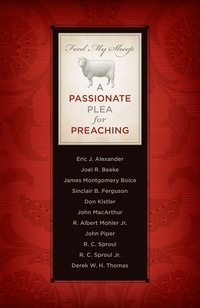
Behold, I am giving away a new copy of a great book entitled A Passionate Plea for Preaching, published by Reformation Trust. The book features essays by Eric J. Alexander, Joel R. Beeke, James Montgomery Boice, Sinclair B. Ferguson, Don Kistler, John MacArthur, R. Albert Mohler, Jr., John Piper, R.C. Sproul, R.C. Sproul Jr., and Derek W.H. Thomas. I have read the Kindle edition and can highly recommend the book.
The Rules: You may only enter the drawing once. To enter, simply fill out your name and email address in the form below. The winner will be notified by email. As soon as the winner has been chosen, all names and e-mail addresses will be permanently deleted. You will not be spammed as a result of entering the drawing. This giveaway closes Monday, March 19 at noon central time, so enter right away!
Monday, March 12, 2012
QOTD - We Are Drifters in Need of Grace
D.A. Carson, from his book For the Love of God, page 23:
People do not drift toward Holiness. Apart from grace-driven effort, people do not gravitate toward godliness, prayer, obedience to Scripture, faith, and delight in the Lord. We drift toward compromise and call it tolerance; we drift toward disobedience and call it freedom; we drift toward superstition and call it faith. We cherish the indiscipline of lost self-control and call it relaxation; we slouch toward prayerlessness and delude ourselves into thinking we have escaped legalism; we slide toward godlessness and convince ourselves we have been liberated.
Thursday, March 01, 2012
Without Scripture We Fall Into Error
John Calvin in the Institutes of the Christian Religion, 1.6.3
Suppose we ponder how slippery is the fall of the human mind into forgetfulness of God, how great the tendency to every kind of error, how great the lust to fashion constantly new and artificial religions. Then we may perceive how necessary was such written proof of heavenly doctrine, that it should neither perish through forgetfulness nor vanish through error nor be corrupted by the audacity of men. It is therefore clear that God has provided the assistance of his Word for the sake of all those to whom he has been pleased to give useful instruction because he foresaw that his likeness imprinted upon the most beautiful form of the universe would be insufficiently effective.God always knew that would would need the Word.
Thursday, February 23, 2012
Our Desperate Need for the Father
The New York Times recently ran an astonishing story with the headline "For Women Under 30, Most Births Occur Outside Marriage."
As it happens, this week I'm called upon to preach Matthew 6:9-15, Jesus' gift of prayer to the church. During my preparation, I ran into this quote from Dale Bruner in his terrific commentary where he says this about Matthew 6:9b and the words "Our Father"
The modern "Our Parent" or the politically correct "Our Father and Mother God" will not do. The first reason for keeping "Our Father" is simply Jesus' command, "Pray like this: Our Father." But another reason is the desperate need in modern culture for the return of the father. In a book that stirred Europe, A. Mitscherlich's Auf dem Weg zur vaterlosen Gesellschaft (1982) ("On the Way to the Fatherless Society"), a world is described in which fathers appear in children's life only late at night as ghost figures or in "progressive" American entertainment as mainly parodies (Gnilka, 1:231). And for those who have even more lamentably experienced their fathers as unspeakable horrors, it can be argued that the remedy for a bad father is not the still greater removal of any father figure at all; it is the gift of a finally good Father. The Lord's Prayer gives this gift....the desperate need in modern culture for the return of the father. Indeed. The epidemic of producing fatherless children will prove to be a disaster, unless the Holy Spirit grants to us a true revival that, in turn, produces a renewed love for God and His precious and holy Word.
Our Father in heaven, hallowed be your name. Your kingdom come, your will be done, on earth as it is in heaven. Give us this day our daily bread, and forgive us our debts, as we also have forgiven our debtors. And lead us not into temptation, but deliver us from evil. (Matthew 6:9b-13).
Tuesday, February 07, 2012
"And when pride hath made the sermon..."
Richard Baxter, in his amazing book The Reformed Pastor, gives this piercing diagnosis of what happens when pride makes the sermon:
And when pride hath made the sermon, it goes with us into the pulpit, it formeth our tone, it animateth us in the delivery, it takes us off from that which may be displeasing, how necessary soever, and setteth us in pursuit of vain applause. In short, the sum of all is this, it maketh men, both in studying and preaching, to seek themselves, and deny God, when they should seek God’s glory, and deny themselves. When they should inquire, What shall I say, and how shall I say it, to please God best, and do most good it makes them ask, What shall I say, and how shall I deliver it, to be thought a learned able preacher, and to be applauded by all that hear me? When the sermon is done, pride goeth home with them, and maketh them more eager to know whether they were applauded, than whether they did prevail for the saving of souls. Were it not for shame, they could find in their hearts to ask people how they liked them, and to draw out their commendations. If they perceive that they are highly thought of, they rejoice, as having attained their end; but if they see that they are considered but weak or common men, they are displeased, as having missed the prize they had in view.Lord, please kill all pride in your chosen heralds. Amen.
Wednesday, December 07, 2011
Matthew #17: You Are Salt and Light
Sermon Text: Matthew 5:13-16
Introductory Comments
The Sermon on the Mount moves now from the beatitudes, which we finished last week, to a couple of clear declarations by Jesus about who the disciples are. Disciples of Jesus are salt, and they are light. We should note that Jesus does not say that the disciples should be salt and light, or ought to be salt and light. Disciples are both these things. So the big questions you need to ask yourself, the question that stands over this text for all disciples of Jesus, including me, is this: Am I living as the kind of person I actually am in Jesus Christ, or am I not? Let that question settle in your minds as we begin to unpack each of these terms.
One of the things Jesus is very, very good at is using the most familiar things to illustrate eternally important truths about who humans are, and in his case who his disciples are.
Disciples Are Seasoners
Let’s begin with verse 13:
“You are the salt of the earth, but if salt has lost its taste, how shall its saltiness be restored? It is no longer good for anything except to be thrown out and trampled under people's feet.Several years ago there was a trend in the publishing business where writers would present histories of commodities, things like gold, coffee, sugar, and such. I happened to buy one of these books, a very interesting book called “Salt: A World History” by Mark Kurlansky. You might be thinking: What on earth could be so interesting about the stuff that we sprinkle on our food using little shakers or packets to give food some ping? Salt merits a “world history?” In fact, it really does, and the short little book makes the case very well. Did you know, for example, that there were times in human history when salt was worth more than gold by weight? More than just a seasoning for food, salt was at times a medium of exchange (money). It’s used as a preservative. The phrase, “that person is worth their salt” refers to a time when salt was actually used to pay salaries, a word that is derived from the word salt.
Beyond its uses in the world, salt is essential to human life. If you sodium levels get too low in your body, a condition known as hyponatremia, you might suffer from nausea, confusion, fatigue, muscle weakness or cramps, even seizures. That is why products like sports drinks contain salts. If you work out and just drink a bunch of water, you might dilute the salt content of your body too much, and so these drinks include salts to ensure that this doesn’t happen.
So salt is critically important for a variety of reasons. We may take it for granted, but salt is an essential element of flourishing human life.
This means that Jesus is making a very important statement about the disciples. When he calls them “the salt of the earth,” he is telling them that they, like salt, are an essential component of human life and flourishing. That has radical implications for those of us who are disciples of Jesus Christ. We are granted, by virtue of our discipleship, an extremely important position in the world. Dale Bruner thinks referring to the disciples as salt means that Jesus, “is very fond of us."1
When Jesus says, “you are” that is a plural you. The disciples are the salt of the earth. Because he is referring to the disciples as an assembled group this scripture today refers to the church. The church collectively, and individually, has a high calling by Jesus. You all are of critical importance to the world. The world might view the church as a relic of a bygone era, but Jesus has established it as the means of human flourishing for the world.
Salt, as I’ve said, has lots of applications. For example, salt seasons food that is bland and tasteless. Disciples of our Lord Jesus Christ are the seasoning that gives flavor to bland and tasteless lives. At the conclusion to his letter, Paul gives the Colossians directions about how to behave toward those who are outside the faith. Colossians 4:5-6 says
Walk in wisdom toward outsiders, making the best use of the time. Let your speech always be gracious, seasoned with salt, so that you may know how you ought to answer each person.Do you know anybody who has ever complained that they just can’t find meaning in their lives, or that their lives are boring? This isn’t the case with the Christian, who has been made eternally alive in Christ and who has a passion to bring that same vibrancy of life to others. That is what it means to be salt. To be salt of the earth means that Christians have a global calling to be the salt that brings flavor to tasteless lives.
Jesus knows what he’s doing when he equates his disciples with the incredibly valuable commodity of salt. Being the salt of the earth is way more than just doing good things for people, being salt brings life to people. A human being will die without adequate salt in the body. Similarly, people will suffer eternal death unless the church is what our Lord says she is, the salt of the earth, the means of sustaining eternal life in people that would otherwise only know eternal destruction. To be the salt of the earth means to bring the message of salvation and hope and joy to those who don’t know where to find them, who are lost apart from the saving sacrifice of Jesus Christ.
Jesus is clear what happens if we don’t live as the people we are created to be. If we aren’t salt of the earth, if we say that we are followers of Jesus and yet do not live as the salt of the earth, then we are, as Jesus says, “no longer good for anything except to be thrown out and trampled underfoot.” It is when we do not live as the people we are that we become useless in the world. The church today struggles to find meaning and relevancy in the world. It would do better to remember what it already is, salt of the earth. This truth should permeate our own church and our own lives. If we are the salt of the earth, then life will not be boring for us. Bruner speaks truth when he says, “Salt does not exist in itself.” Salt is useless if it just sits there. If we are not living as the salt of the earth, the earth will simply not be interested in the church at all.
You Are the Light of the World
Jesus now uses another metaphor to call his disciples into action, in Matthew 5:14-16
“[14] You are the light of the world. A city set on a hill cannot be hidden. [15] Nor do people light a lamp and put it under a basket, but on a stand, and it gives light to all in the house. [16] In the same way, let your light shine before others, so that they may see your good works and give glory to your Father who is in heaven.Our Lord Jesus also declares that his disciples “are the light of the world.” We were warned about uselessness in the previous verse, but now Jesus grants to us the assurance that, if we are truly his disciples, we will be put to kingdom use.2 We are the light of the world. And the one who is the source of that light won’t hide it under a basket, but will place that light high up on a stand, where its rays might shine to the greatest extent.
God did not save you and then forget about you. He saved you for a purpose that is outside of yourself.
Our Light Is A Reflection of Jesus’ Glory
As the light of the world, we are to let our light shine, unbounded by constraints or worries about what others might think, so that when the world sees us and the good things we were saved to do, they will desire to give glory to the Father. When people look at the church, at any local congregation of believers, we should not be surprised, but rather hope that they ask some questions: “What is with these people? They are doing good things, but they’re not seeking credit for them. They don’t seem to care if nobody notices the good things they do? What’s up with that?”
Earlier this year, Sara and I attended a conference on Missions held in Minneapolis. There were several pre-conference talks on the schedule, and since we live in Minnesota we arrived early and were able to take in several of these presentations.
One of the first presentations was by a man named Jeff Vanderstelt who is big into missional communities and their role in planting new churches. Every member of Jeff’s church has to make a firm commitment to mission in his or her lives and have to plan how that is going to happen.
One day, Jeff and his fellows were meeting with a married couple that stated that they wanted to be salt and light in their communities, but then some reasons came out for why this wouldn’t be possible. The husband was a full-time student, and the wife worked to support the family and their three children. The woman, in particular, had concerns that in order to be effective in mission, she would need to quit her job and become a stay-at-home mom of three. There just wasn’t space in the schedule to participate in most of the mission activities of the community.
In response, Jeff and the group with asked the question: What would it take to allow you to quit your job, become a stay at home mom, and do the work of mission for the glory of Christ?
The mom looked back, wondering what was up. “What do you mean?” she asked. “We mean, how much money would it take to allow you to quit your work and take up a mission opportunity for Jesus.” The woman couldn’t believe what she was hearing. She told them what it would take. Immediately, the people in attendance make concrete financial commitments until the total number was achieved. Then they gave her the money.
What happened next is very interesting. This woman began telling others about how this amazing thing had happened, that her church friends had secured a way for her financially to throw herself more deeply into the mission of the church. People were happy, and wanted to know how such a thing was possible. When she told them what happened, there were lots of quizzical responses, especially from nonbelievers. They wanted to know why anyone would part with their own financial resources to allow someone else to quit their job and take on a life of mission for Jesus. All of those questions allowed the woman to tell them about Jesus, about how Jesus Christ produces people with these capabilities and capacities and empowers them to serve him.
Jeff Vanderstelt concluded this story by saying that is how others should see our lives. If we are salt and light, people will wonder what on earth is going on. What is with these people? What makes them tick? Why do they do the things they do? The only answer that makes sense is that it is the gospel that makes these kinds of people. It is Jesus who calls people from dead, tasteless lives and saves them, through his sacrificial death on a cross, and then gives them a commission and empowers it with the Holy Spirit so that we can be his missionaries, proclaiming his word and showing his love to a broken down, bland world shrouded in darkness. Disciples are salt and light, and live in such a way that the only answer for why they live together and love each other as they do is because of what Jesus has done for them.
A big, big problem for the church today is that people, when they see the church, too often see a pale image of the bland, dark world they already live in. The answer isn’t to work harder or to promote ourselves more. The answer is to remember what we already are in Jesus Christ.
Believers, disciples, followers of the Lord Jesus Christ, you are the salt of the earth. You are the light of the world. You don’t need wonder about this, because your Lord has established this truth by his own word. Maybe you’re wondering what the next step it. Let’s talk about that. There are so many ways God can make use of your in your roles as salt bearers and light bringers. You are already qualified for the work because you believe in Jesus and have the indwelling presence of the Holy Spirit. Christian discipleship all about becoming what you already are. That means you are free to take some risks. You’re free to walk away from a job, free to turn off the TV, go outside and tell someone about Jesus without fear. You’re free to volunteer in one of the church’s helping ministries. You’re free to teach children about the bible. You’re free to stand up here on a Sunday to help lead the worship of our God and King. You’re free to prepare and deliver food to saints and others who have need. You’re free to give generously to the ministry and mission of the church. You’re free to sponsor a child through World Vision or a similar ministry. You are after all, salt and light. You were made to bring zest and flavor to the lives of others. You were made to reflect the very glory of God to others. You were saved for this. Let’s get to it. Amen.
1Bruner, Frederick Dale. Matthew: A Commentary. Vol. 1. Grand Rapids, MI: W.B. Eerdmans Pub., 2007. 188.
2Ibid.
Given at First Presbyterian Church in Jackson, Minnesota
December 4, 2011
2nd Sunday in Advent
Copyright © 2011 by Christopher Donald Drew
Tuesday, November 29, 2011
Matthew #16: Blessed Are the Persecuted Ones
Scripture Text: Matthew 5:10-12
Introductory Comments
This week, while so many in our country were enjoying Thanksgiving and shopping, great blessings of liberty granted by to us as undeserved gifts from God, I spent some time in preparation for this sermon looking through news stories posted at a website of the organization “The Voice of the Martyrs” (at www.persecution.org). Before I share them, I want to let you know that these difficult stories are not something we are used to hearing. But I think we need to hear them, because Christians globally are part of the same body. 1 Corinthians 12:26 says, “If one member suffers, all suffer together; if one member is honored, all rejoice together.” When a member of the body of Christ is persecuted, we ought to know about it.
Kenya - Last Saturday, Nov. 5, suspected extremists sympathetic to al-Shabab threw a grenade into a church elder’s home outside Garissa, Kenya, killing 8-year-old Winnie Mwenda Mutinda and 25-year-old John Kikavu. Three others in the house were seriously injured. The church’s pastor, Ibrahim Makunyi Kamwaro, told Compass Direct News that the three injured Christians are now in stable condition after undergoing treatment. … Despite the threats and attack, the church continued its worship service the next day.1The website has page after page of news alerts and updates from across the globe. Some of the stories are much more violent that the sample I’ve chosen. You may also remember, from an earlier sermon, my mention of Pastor Youcef Nadarkhani who still, as far as we know, continues to languish in an Iranian prison cell under a death sentence, separated from his family, for the crime following Christ. The much-lauded, so-called “Arab Spring” in places like Egypt and Libya has, tragically, often brought more rather than less persecution upon disciples of our Lord Jesus.
Burma - A young Christian in Myanmar was forced to choose between faith and family recently when her relatives demanded that she recant her faith. On Sept. 19, 2011, 21-year-old Ying was preparing to leave for classes at an underground seminary when her relatives locked her in the house. They threatened to disown her, beat her and withdraw support — including food — if she continued to attend seminary or church. In addition, they threatened to send her to a remote village with no known Christians if she did not recant her faith. Instead of giving in to their demands, Ying ran away from home and left her family behind2
Nigeria – Muslim extremists carried out new attacks on villages in Nigeria’s Plateau state in September, killing more than 100 Christians, including entire families, according to Compass Direct News.3
China – In another example of the ongoing crackdown against house churches in China, house church pastor Shi Enhao was sentenced to two years in a labor camp last month. Pastor Shi, who serves as deputy chairman of the Chinese House Church Alliance, was charged with “illegal meetings and illegal organizing of venues for religious meetings.” The charges stem from the fact that Pastor Shi’s house church of several thousand meets in different sites around Suqian city.4
This week, my wife Sara lent me her copy of a novel entitled Safely Home by Randy Alcorn, strongly encouraging me to read it. The novel is about the extreme persecution of Christians in China. While a work of fiction, the novel nonetheless includes accounts of actual persecutions in that country – persecutions that are never known about or reported because of media lockdowns in that country, and because of our country’s willingness to turn a blind eye to these things for the sake of tapping into the explosive economic growth in that country – growth that is, among other things, supported through the deployment of prisoners as slave laborers.
It is interesting to me, then, that on this first Sunday of Advent God would, in his providence, give us this text from Matthew for the sermon. Traditionally, the first Sunday in Advent is devoted, not to the first, but to the second coming of our Lord Jesus, the final Advent when he will come in final judgment, bringing eternal punishment for those who reject him and eternal vindication for those millions of Christians who, because they do not enjoy the religious liberties like those of our own country, suffer intensive persecution for the sake of their faith in Jesus Christ, Lord and King of all the nations.
One Beatitude? Or Two?
Our text is frequently counted as two separate beatitudes, but many scholars believe verse 11 to be a flushing out of the beatitude in verse 10. And as I have read and prepared for this sermon, I lean toward this interpretation. Why? The two verses are very similar. Both speak of persecution. Both speak of blessing and reward for suffering persecution. It seems clear, however, that verse 11 answers three questions about verse 10: First, what is the persecution Jesus is speaking about? Second, what is the “righteousness” which incites the persecution? Third, who are the ones being persecuted?
What Kind of Persecution?
In verse 10, Jesus says, “Blessed are those who are persecuted for righteousness' sake, for theirs is the kingdom of heaven.” The blessing is limited in scope to those who are persecuted. What kind of persecution is this? The answer, I believe, is given in verse 11: “Blessed are you when others revile you and persecute you and utter all kinds of evil against you falsely on my account.”
To be persecuted is to be reviled by others, which means being criticized in a deeply angry, insulting way. These persecuted ones are people against whom all kinds of evil are charged, falsely. One of the earliest examples of persecution in the ancient church was the false charge that Christians engaged in ritual cannibalism. This was probably the result of misunderstanding what was happening at the Lord’s Supper and references to the body and blood of Jesus. Christians were also accused of atheism, which may seem very strange, but the source of the charge was the Christian refusal to worship the state-sanctioned gods of the Roman Empire. Any such refusal was considered to be a declaration that the gods did not exist, when in fact Christians were worshiping the only God in existence. Many suspected that ancient Christians were immoral libertines, engaging in incest and orgies. We live today in an almost 180-degree environment, where orthodox Christian are now maligned for holding to old-fashion, fuddy-duddy sexual ethics, which happen to be biblical, while false idol of sexual libertinism is now celebrated by the world.
What Is the Righteousness that Incites the Persecution?
Persecution will come, says Jesus, for “righteousness’ sake.” What is this righteousness that incites persecution? What kinds of pursuits are righteous? We can only know of righteousness through God’s revealed will for us in the Scriptures. Christians need to be lovers of God’s Word, but they need to know that adhering to the Word as truth will bring persecution. We guard ourselves against false piety and false interpretation by consulting the Word with other faithful, orthodox believers.5
But something deeper can be said to answer this question from verse 11. In verse 10, those who are persecuted are persecuted for “righteousness’ sake.” I think Jesus tells us what this means in verse 11. There, he makes things very personal.
“Blessed are you when others revile you and persecute you and utter all kinds of evil against you falsely on my account.”The “those” in verse 10 are called “you” in verse 11. The “you” in verse 11 is explicitly the disciples, and in this reading today that includes all of you who are disciples of Christ. You will be reviled, persecuted, and evilly slandered because of your relationship to Him, Jesus. Jesus says this persecution will come “on my account.” This is really why I think there is a linkage between verses 10 and 11. We know from the bible that no one, including Christians possesses any righteousness in themselves. Paul, in Romans 3:10, quotes the psalmist when he writes
as it is written: “None is righteous, no, not one; no one understands; no one seeks for God.So what is the righteousness that is pursued and, as a result of being pursued, brings persecution? It is the righteousness that is Jesus Christ. Paul explains this in 1 Corinthians 1:30:
And because of him you are in Christ Jesus, who became to us wisdom from God, righteousness and sanctification and redemption, so that, as it is written, “Let the one who boasts, boast in the Lord.”Christ is our righteousness. Christ is our righteousness because we do not have any righteousness of our own. This is the essence of the gospel. If you acknowledge before God your sin, confess it, and acknowledge that Jesus is Lord and your only hope of righteousness, you are saved. The reason you are saved is that by faith in Jesus, His righteousness is imputed to you, it is credited to your account and you are totally free from condemnation for sin.
But it is this very relationship to Jesus as Lord that will invite persecution. The implications are huge: Persecution is a marker of being a disciple. If you are a follower of Jesus Christ, you will be persecuted for it. Why? Because if you are a follower of Jesus, and not just a fan, everything else in life takes second place. If Jesus is the object of your love and affection and loyalty, that means your nation isn’t, and that will invite persecution. If Jesus is your first love, that means your families are not, and that will invite persecution (remember the daughter who ran away from her home?). If Jesus is your love, then his Word, his commandments and expectations will always come first, and not those of the world, and that will invite persecution. If Jesus is your highest treasure, that means other gods and religions and spiritualities are not, and that will invite persecution. This has always been the case.
Bruner remarks that "Christians are only supposed to get into trouble for the right reasons."6 Jesus is the right reason.
My Desire for Our Church
One of the reasons I opened with the stories of persecution is that I wanted to awaken in you a desire to stand with those who are persecuted. This is the responsibility, I think, of those who enjoy a much greater degree of freedom to worship than many millions of our brothers and sisters. I desire us to be a people who, while not persecuted, have the passion for Christ of the persecuted, the compassion of the persecuted, the drive of the persecuted, the perseverance of faith of the persecuted, the risky lives of the persecuted, the audacity of the persecuted. My hope is that God will use the promise of this blessing in this message to set all of us free from our complacency and our need to live in constant comfort and with approval from others to live for the approval of the only One in the universe whose approval actually matters, Jesus Christ.
I want to remind you of the promise of Jesus of the great rewards that await those who are faithful amid persecution. The rewards for those women and men are amazing. We ought to rejoice that God has created such people, people whose faithfulness to Christ has ignited gospel revival. May we also receive such grace.
Our Response for Those Persecuted
What can we who do not routinely experience extreme persecution to do in solidarity with persecuted brothers and sisters do? There are several things.
First, we should always remember persecuted brothers and sisters in Christ in our prayers. We should pray for their safety, for the perseverance of their faith, for their families, that beatings and torture will not weaken but actually strengthen their faith, and for the continued spread of the good news of the gospel.
Second, in many countries there is a shocking shortage of bibles. One of the paramount pleas of the persecuted, underground churches is for copies of God’s living Word. We have so many bibles sitting on shelves here in the United States. Perhaps someone could organize a drive to get bibles to brothers and sisters who are starving for God’s Word.
Third, and this is from our text, we ought to rejoice! We need to sing God’s praises for his power and might in creating such faith in the hearts of the persecuted. As we look over the lists of those who are martyred for the faith, even as the tears may flow, sing praises to God for faith and for faith’s reward, the eternal inheritance of the kingdom of God for those who are in Christ Jesus.
And on this first Sunday in Advent, let’s us pray that the second coming of our Lord might come soon. The writer of Hebrews had this to say to his listeners:
But recall the former days when, after you were enlightened, you endured a hard struggle with sufferings, sometimes being publicly exposed to reproach and affliction, and sometimes being partners [we are those partners today] with those so treated. For you had compassion on those in prison, and you joyfully accepted the plundering of your property, since you knew that you yourselves had a better possession and an abiding one. Therefore do not throw away your confidence, which has a great reward. For you have need of endurance, so that when you have done the will of God you may receive what is promised. For,
“Yet a little while, and the coming one will come and will not delay; but my righteous one shall live by faith, and if he shrinks back,my soul has no pleasure in him.”
But we are not of those who shrink back and are destroyed, but of those who have faith and preserve their souls. (Hebrews 10:32-39 ESV)Our Lord Jesus Christ said:
Blessed are those who are persecuted for righteousness' sake, for theirs is the kingdom of heaven.Rejoice and be glad, brothers and sisters. Lord Jesus, come soon! Amen.
Blessed are you when others revile you and persecute you and utter all kinds of evil against you falsely on my account. Rejoice and be glad, for your reward is great in heaven, for so they persecuted the prophets who were before you. (Matthew 5:10-12 ESV)
1http://www.persecution.com/public/newsroom.aspx?story_ID=NDQ1
2http://www.persecution.com/public/newsroom.aspx?story_ID=NDMy
3http://www.persecution.com/public/newsroom.aspx?story_ID=NDMw
4http://www.persecution.com/public/newsroom.aspx?story_ID=NDA3
5Bruner, Frederick Dale. Matthew: A Commentary. Vol. 1. Grand Rapids, MI: W.B. Eerdmans Pub., 2007. 181.
6Ibid.
Given at First Presbyterian Church in Jackson, Minnesota
November 27, 2011
First Sunday in Advent
Copyright © 2011 by Christopher Donald Drew
Subscribe to:
Posts (Atom)

